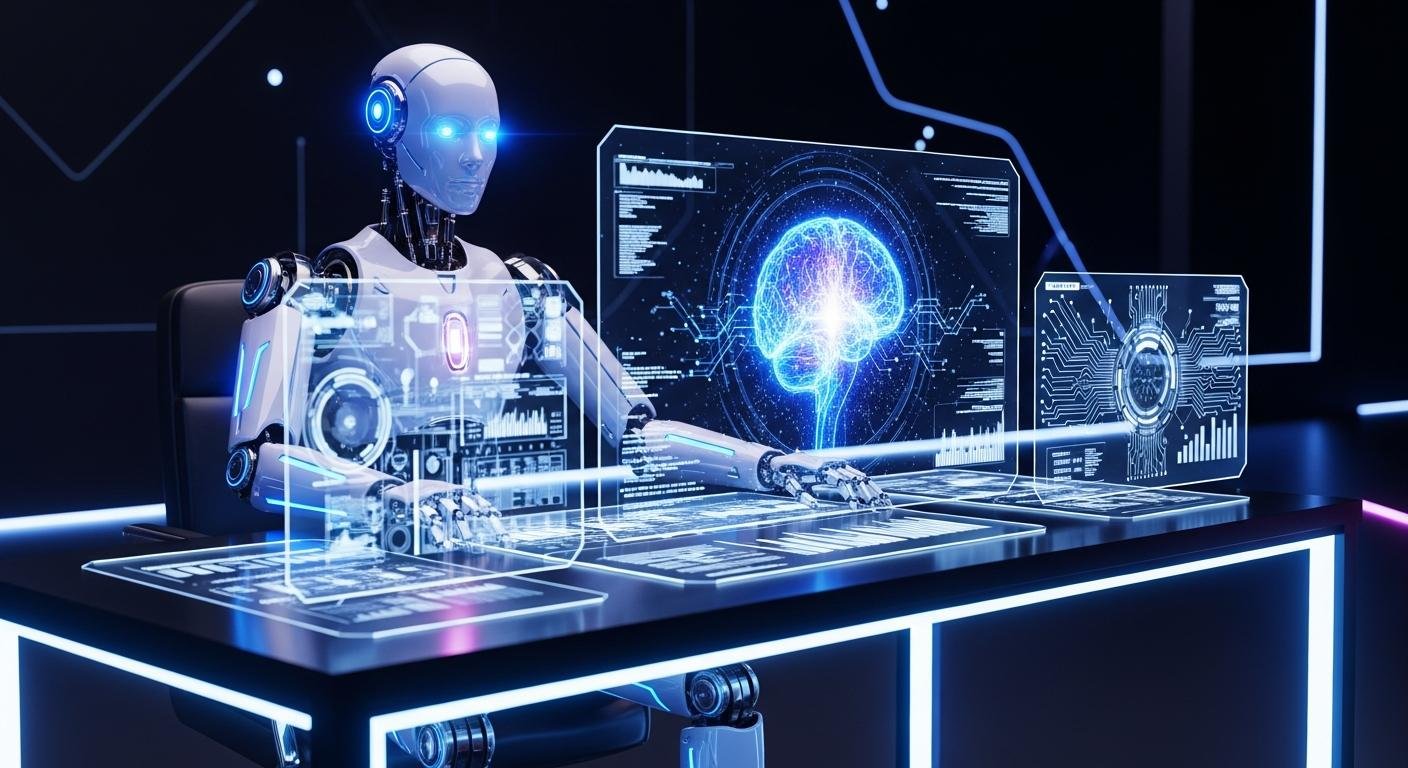
Artificial Intelligence (AI) is evolving rapidly, and one of the biggest developments in 2026 is the rise of AI agents. Unlike traditional AI chatbots that mainly respond to questions, AI agents can understand goals, plan tasks, use digital tools, and complete multiple steps with limited human intervention.
From managing business operations to assisting software developers, AI agents are changing how people interact with technology.
Businesses are increasingly exploring autonomous AI systems to reduce repetitive work, improve productivity, and make faster decisions. According to technology industry forecasts, multi-agent systems and agentic AI are among the important technology trends shaping 2026.
Gartner+1
What Are AI Agents?
AI agents are intelligent software systems designed to perform tasks based on user instructions or predefined objectives.
For example, a traditional chatbot might tell you how to schedule a meeting. An AI agent could potentially check calendar availability, identify suitable times, prepare an invitation, and request approval before sending it.
Most AI agents combine several technologies:
-
Large Language Models (LLMs)
-
Natural Language Processing (NLP)
-
APIs and external tools
-
Memory and contextual understanding
-
Planning and decision-making systems
-
Automated workflows
How Do AI Agents Work?
The working process of an AI agent generally involves five stages.
1. Understanding the objective
The agent receives a request and identifies the expected result.
2. Planning the task
It breaks a complex objective into smaller actions.
3. Using tools
It can interact with APIs, databases, websites, or connected software, depending on its permissions.
4. Executing actions
The agent completes approved tasks and checks the results.
5. Evaluating the outcome
It reviews whether the objective has been achieved and determines whether additional actions are required.
Top Applications of AI Agents in 2026
Business automation: AI agents can help manage customer inquiries, prepare reports, organize information, and automate administrative workflows.
Software development: Coding agents can assist with writing code, finding errors, creating tests, and documenting software.
Digital marketing: AI systems can help research keywords, prepare campaign drafts, analyze performance, and organize content calendars.
Customer support: AI agents can handle common questions, retrieve account information, and escalate complex requests to human employees.
E-commerce: Intelligent agents can support product discovery, order tracking, customer assistance, and personalized shopping experiences.
Benefits of AI Agents
-
Reduce repetitive manual tasks.
-
Improve workflow efficiency.
-
Support faster information processing.
-
Provide assistance around the clock.
-
Help businesses scale operations.
-
Connect multiple software applications.
Challenges and Risks
AI agents are powerful, but they are not perfect.
They can misunderstand instructions, produce incorrect information, or take unintended actions if permissions are poorly configured. Businesses should implement access restrictions, activity monitoring, human approval for sensitive actions, and regular security testing.
The Future of AI Agents
AI agents are likely to become an important part of digital workplaces. Instead of using separate tools for every small task, people may increasingly coordinate teams of specialized AI agents through a single interface.
However, human judgment, accountability, and security will remain essential.
Frequently Asked Questions
Q1. What is an AI agent?
An AI agent is a software system that can understand objectives, plan actions, use tools, and perform tasks with varying levels of autonomy.
Q2. Are AI agents better than chatbots?
They serve different purposes. Chatbots primarily communicate with users, while AI agents can also perform actions and manage multi-step workflows.
Q3. Can AI agents replace human employees?
They can automate certain repetitive tasks, but human expertise remains important for decision-making, creativity, supervision, and complex responsibilities.
Q4. Are AI agents safe to use?
They can be useful when configured correctly. Businesses should apply permission controls, data protection, monitoring, and human approval for important actions.
Conclusion
AI agents represent an important evolution in artificial intelligence. They are moving AI beyond simple conversations and into practical task execution. Businesses, developers, and individuals who understand their capabilities and limitations will be better prepared for the next generation of automation.